
“1984” is one of my favorite novels. I’ve easily read it six times, and I’ll surely read it several more before I pass on. For such an intense read, it’s a surprisingly quick one; no more than a couple of hours long. The story is told with such clarity and economy that there’s virtually no fat on the whole affair.
Orwell’s dystopian story continues to resonate 75 years later because we feel echos of its warnings throughout our society: ubiquitous screens and surveillance, language policing, the rampant spread of disinformation and the power created by a hated “other.” The details aren’t always the same — Orwell might be surprised that we pay for and willingly carry around our own screens and cameras and broadcast our own self-surveillance for followers and brand deals — but his core point still rings eerily true: if you control the past, you control the future.

Every franchise today seems to require a complete universe, lest we don’t know the marital history of the blue elephant pianist from “Return of the Jedi” (watch “Finding Rebo,” coming soon to Disney+!), and now “1984” has its own alternative view of the mainline story from another character’s perspective. Instead of focusing on Winston Groom, Sandra Newman’s “Julia” tells the story from the parallel point of view of the eponymous title character. Julia is, whatever you think of Orwell’s storytelling prowess, an underdeveloped character in “1984,” owning largely to the first-person nature of the book. We only know of Julia what Winston knows, and since he’s borderline cracked for the entirety of the story, she never really emerges as a complete person. Newman’s book turns the tables on that in some interesting ways.
Some spoilers follow, so don’t read anymore if you think you’ll want to read “Julia.” TL;DR: it’s worth reading.
“Julia” was written with the blessing of the Orwell estate, which will beg the inevitable question of whether it is canon to the events of Orwell’s book. The only possible answer is “it doesn’t matter.” If you feel like it’s canon, then great for you. For me, the book didn’t fit my sense of Julia’s role in the original story, so I’m inclined to treat it as an interesting, very compelling, fan fiction.
The book takes place mostly during the events of “1984,” though it does have scenes that take place well before and well after. There’s context for how society collapsed in the way Orwell describes, how that drove Julia to her secret double life, and how the world eventually begins to put itself back together after his book’s narrative ends.
Most of the novel is what you’d probably expect, focusing on what it would be like for women to live in the society envisioned in “1984,” and those are by far the most compelling moments in the book. The way the women create secret shibboleths and black markets feels authentic to the original narrative, with many of the same scenes present in both books, but from two different perspectives. We see “Julia” as more bold than Winston, always living on the edge of being caught by the Thought Police, but also seeming to care little about the consequences of her actions.
There is a surprising amount of explicit sex in the book, especially compared to Orwell’s clinical couplings. Julia frequently seeks risky sex with various men as a form of rebellion, which does fit her admission to the same with Winston in Orwell’s version. Orwell might have blushed at the graphic nature of some of the acts described, but it’s also fitting that this is a first-person story from another person’s point of view and Winston’s repressed prudery is a real contrast to Julia’s louche candor.
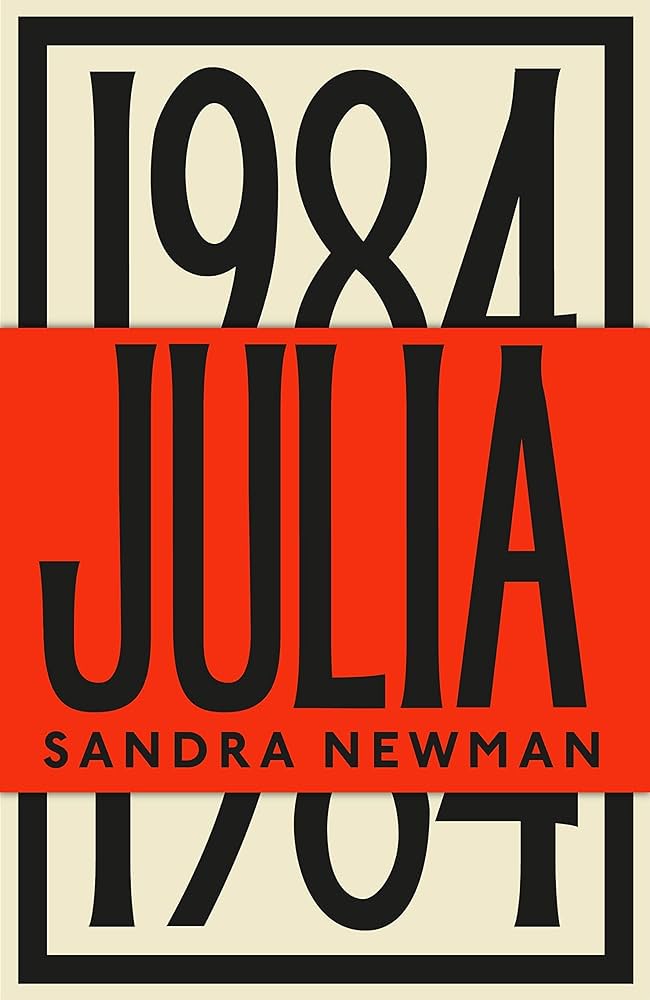
One truly shocking aspect of the book — and again this is the big spoiler — is that Newman asserts that Julia was approached by the Thought Police first and was actually being blackmailed by them to entrap Winston. All of the scenes in the room above the shop take on a strange new light considering that — according to this multiversal variant of the story — Julia knew everything: there was a hidden telescreen in the room, the shopkeeper was a member of the Thought Police, and that they were, in fact, the dead.
It makes for an interesting story and a fascinating new perspective to consider the original book, but I can’t say that I like it as much. There’s something really pure and carnal about Winston and Julia’s rebellious, doomed affair that I always found exciting, and retelling it such that Julia knew it was all a ruse doesn’t really work for me.
It raises interesting questions about what “canon” really means anymore, when “Star Trek” has parallel timelines with many of the same characters portrayed in different ways, Marvel movies present characters who are alligator versions of their human selves, and “Star Wars” has had to purge entire swaths of novels out of the “official” story so that any of it can continue to make sense. In that context, “Julia” is a fun diversion for fan’s of Orwell’s novel, but, for me, it’s best kept as a “What If” story. It’s probably best if cautionary tales about the dangers of changing the past are left just as they always were.





 clontzville.com
Leave a comment