I’m not the world’s biggest sports fan and would never claim to be. Don’t get me wrong, I like sports, but I don’t have a brain that lends itself well to enjoying them. I don’t remember moments or players or stats or trends, and I really don’t care very much about any of it. That’s not to say I can’t enjoy watching a game, but it’s also pretty unusual for me to get too wrapped up in it. Being a hardcore sports fan takes a level of dedication and attention that I’ve just never had, even with teams or sports I like (which is basically the Braves and baseball).
All of that being the case, it was particularly strange to find myself working for Sports Illustrated in 1999. I was in graduate school in New York, and I wanted to move closer to my home in the southeast. I was psyched about work in the nascent “new media” field in Atlanta, and Time Warner had a brief foray into combining their media brands to create deranged hydra abominations — CNN/SI, CNN & Time, CNN & Entertainment Weekly, CNN & Fortune — as part of a ill-fated initiative called NewsStand.
CNN/SI was a genuine multimedia venture, combining the writers of the magazine with a new website, cnnsi.com, and a television network called CNN/SI. I was an “interactive producer” for the site, which may be the most 1999 job title imaginable, which meant that I worked on user-interactive features. We had forums and user pieces where we’d ask readers their opinions and post some of the most trenchant responses later in the day. And we had live chat.
A great deal of my time was spent trying to book, run and transcribe live chats with sports figures or writers. We had a Java-based chat client, as was the convention at the time, and we’d put a link to the room on the home page and hope people would join. We’d have two producers, one monitoring the public chat area where questions were submitted, and the other on the phone with the subject actually conducting and typing the interviews. It was stressful, fast-paced and… deeply weird. Sometimes — if the player wasn’t interesting enough — we wouldn’t get questions from the audience and we’d just have to wing it. Other times you could tell that they were in a car working the press phones, giving you the minimum 20 minutes. One time I talked to an NBA player while he was getting a haircut. Like I said, weird times.
It was a wild time to be a CNN property. Atlanta saw an ice storm that screwed up a Super Bowl the same weekend that Ray Lewis was involved in a stabbing in Buckhead. Y2K kinda-sorta happened and the world didn’t end. The Swimsuit issue was, by far, our biggest traffic day of the year. Then AOL bought Time Warner in one of the most disastrous mergers in business history, and it stopped being fun pretty fast.
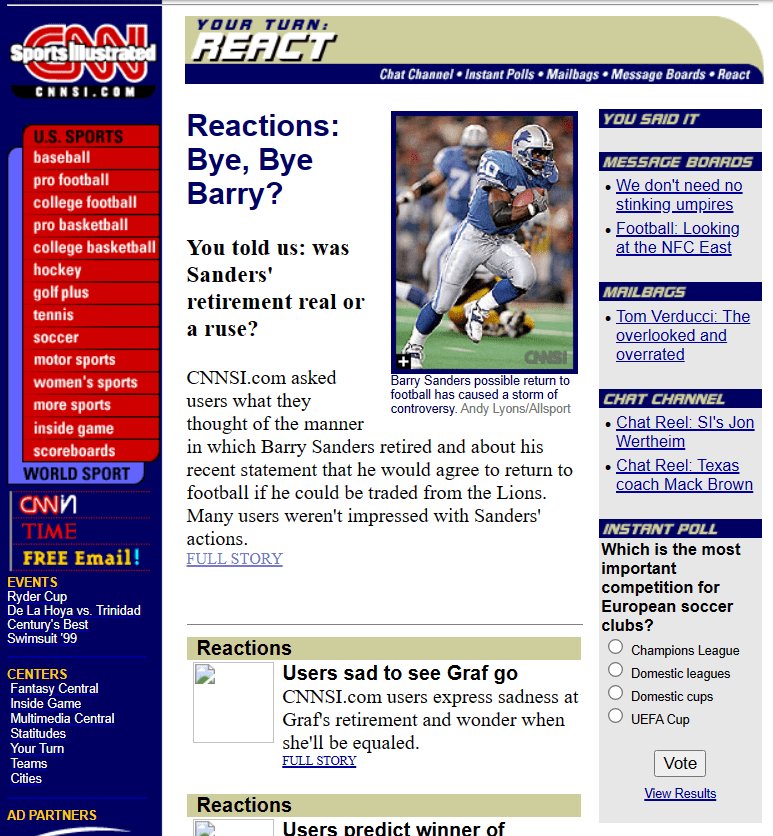
I didn’t stay in that job long, but I did meet some really cool people, some of whom I’ve stayed in touch with. The news last week that the brand has essentially been shuttered, with most of the staff laid off, really bummed me out. I kept a few of my SI’s from when the Braves won the NLCS in 1992 and the World Series in 1995, and there’s something so real and tangible about those magazines. They’re fragments of those moments in a way that the web just can’t be. Even the few snapshots in the Internet Archive of my work during my time are incomplete and buggy because those web pages just were there for a moment, and then they were not.




 clontzville.com
Leave a comment